
CBS Mornings 23 Dec 2016
Back in 1907, a 10-year-old girl living in a New York City apartment in Hells Kitchen wrote a letter to Santa. Following an Irish tradition, she sent it up the chimney. This was a common way of getting a letter to Santa, and there is a similar example from Dublin in 1911.
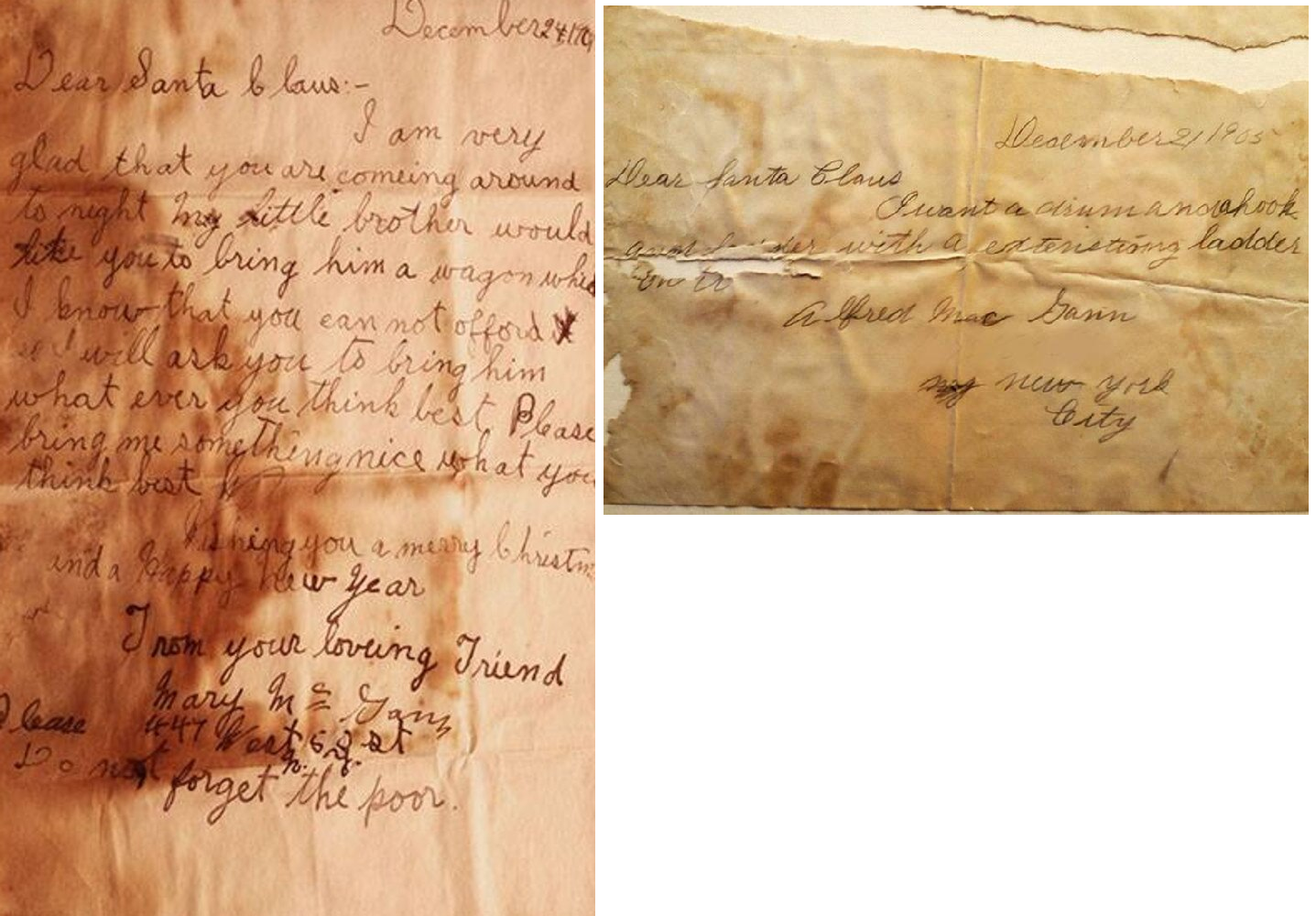
In 1999, the current occupant of the apartment, Peter Mattaliano, was having his fireplace renovated when they found a delicate piece of paper with faint children’s scrawl bearing a request to Santa from a century earlier. “I want a drum and a hook and ladder,” read the letter, adding that the fire truck should be one with an “extentionisting” ladder. It was dated 1905 and signed “Alfred McGann,” who included the building’s address.
There was another item in the rubble: a small envelope addressed to Santa in “Raindeerland.” Inside was a second letter, this one dated 24th December 1907 and written by Alfred’s older sister, Mary, who was 10 years old. It was in a blue envelope addressed to Santa Claus in Reindeerland with a reindeer stamp drawn as postage.
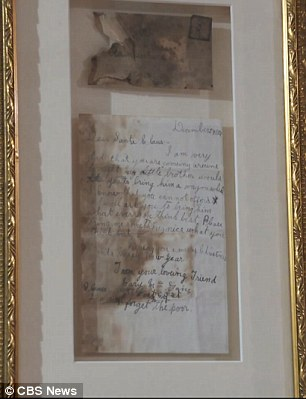
Dear Santa Claus: I am very glad that you are coming around tonight,
My little brother would like you to bring him a wagon which I know you cannot afford. I will ask you to bring him whatever you think best. Please bring me something nice what you think best.
Mary McGann P.S. Please do not forget the poor.
Peter spent the next fifteen years, researching the family he saw the children’s letters as a testament to the immigrant struggle in New York.
Through online genealogical research he discovered that Mary and Alfred were the children of Patrick and Esther McGann, Irish immigrants who married in 1896. Mary was born in 1897 and Alfred in 1900. The family lived at 447 West 50th Street, where Peter Mattaliano now lives. Their father Patrick McGann died in 1904, so by the time the children wrote the letters left in the chimney, they were being raised by mother Mary, a dressmaker and a widow.
By 1920, Mary, Alfred and their mother had moved up to West 76th Street. As young adults, Mary worked as a stenographer and Alfred as a printer. By 1930, Mary had married the similarly named George McGahan and moved to the Bronx, and later to Queens. Her brother also married. Neither sibling appeared to have children and both apparently died in Queens; Mary in 1979, at 82, three years after her husband. She is buried in Flushing. Alfred’s burial location is unclear. He seems to have died childless in 1965 in Queens. His wife, Mae, died in 1991.
According to the New York Times, Peter Mattaliano,” who has read the letter countless times, still shakes his head at the implied poverty, the stoicism and the selflessness of the last line, all from a girl who requests a wagon for her brother first and nothing specific for herself.”
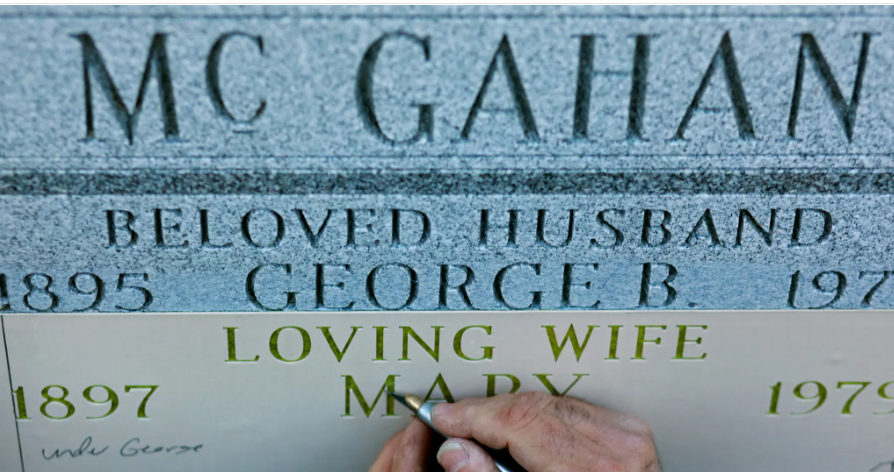
Having solved the mystery of who Mary McGann and where she was buried, he tried to have her name added to the gravestone, saying she deserved to be acknowledged. As her husband pre-deceased her, there was no known living relative to organise the change to the gravestone, Mr Mattaliano was not allowed to authorise this addition as he is not a family member.
Then he heard from a distant cousin of Mary’s, Brian Dempsey, a schoolteacher from Kildare who had read about the story in an artcle in an Irish newspaper. He agreed to send Mr. Mattaliano a notarised letter granting permission to add Mary’s name to her husband’s gravestone. He also sent a bag of soil he scooped from a field near the small farm in Lullymore where Mary’s mother grew up before emigrating.
Eventually the necessary approvals were obtained and in 2016 the stonecutter finished engraving “Loving Wife Mary” into the granite garvestone
on the Night Before Christmas back i